Dua · · 7 min read
Istikhara Dua: Arabic, Meaning and How to Pray Salat al-Istikhara
A job offer, a marriage proposal, a move to another city. The Prophet ﷺ taught his Companions a short prayer for exactly these moments — and he taught it to them as carefully as a surah of the Qur’an.
Short answer: Istikhara means asking Allah to choose what is best for you. When you are deciding something permissible, pray two voluntary rak‘ahs and then say the dua the Prophet ﷺ taught: “Allahumma inni astakhiruka bi‘ilmika…”, naming your matter. It is reported by Jabir in Sahih al-Bukhari. You do not need a dream: after Istikhara, go ahead with what seems right, and Allah makes the better outcome easy or turns it away.
What Istikhara means
Istikhārah comes from khayr, “good”: it is asking Allah for the good — asking Him, with His knowledge and His power, to choose for you. It is for decisions between permissible options. Something that is obligatory needs no Istikhara, and something forbidden cannot be made good by it.
Jabir ibn ‘Abdullah, may Allah be pleased with him, described how important it was to the Prophet ﷺ:
The Prophet ﷺ used to teach us Istikhara in all matters, as he taught us a surah of the Qur’an. He said: “If one of you intends to do something, let him pray two rak‘ahs other than the obligatory prayer, and then say…”
The Istikhara dua
This is the wording in Sahih al-Bukhari. Where you reach hādhal-amra (“this matter”), name your matter — or keep it clearly in mind.
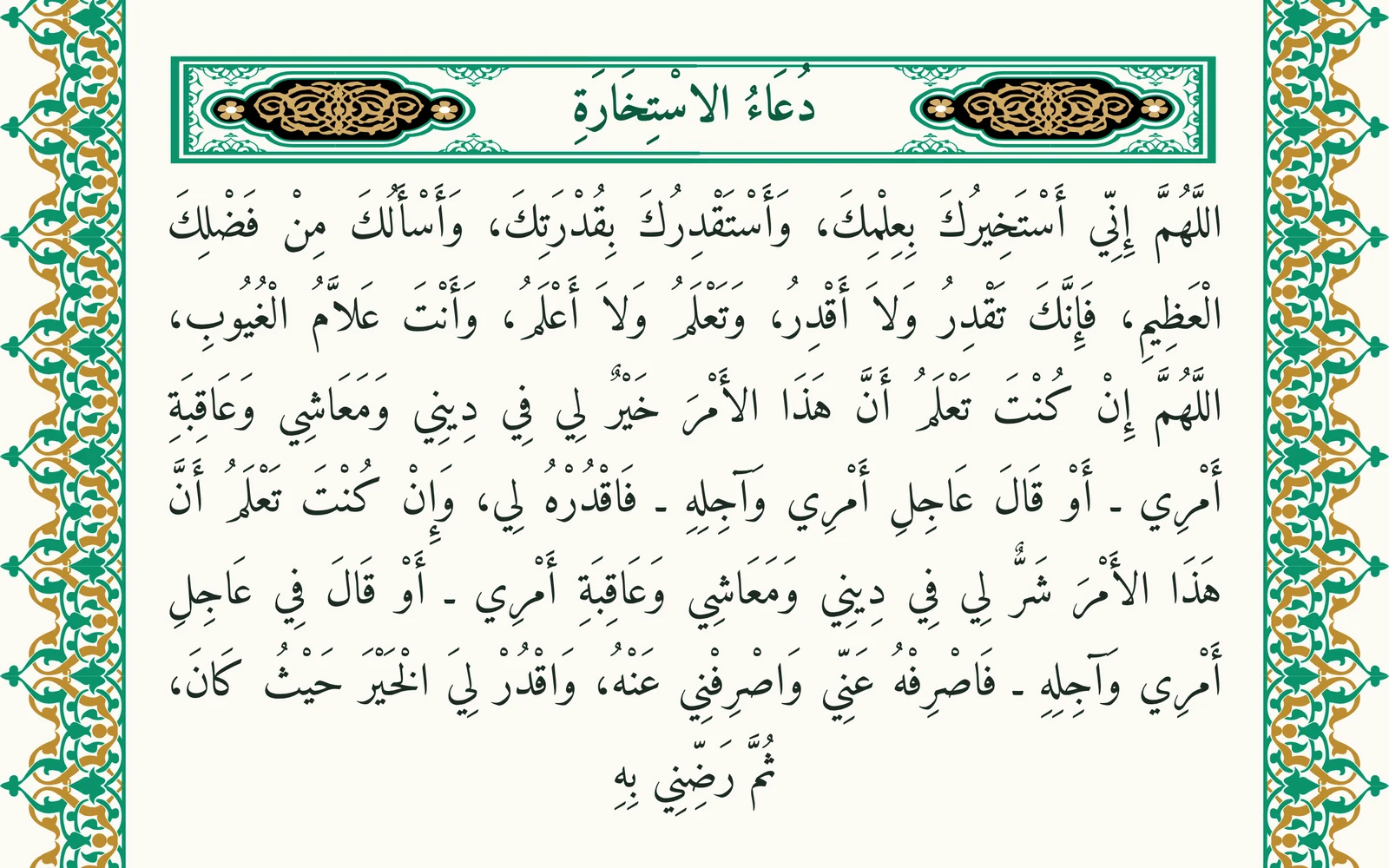
اللَّهُمَّ إِنِّي أَسْتَخِيرُكَ بِعِلْمِكَ، وَأَسْتَقْدِرُكَ بِقُدْرَتِكَ، وَأَسْأَلُكَ مِنْ فَضْلِكَ الْعَظِيمِ، فَإِنَّكَ تَقْدِرُ وَلاَ أَقْدِرُ، وَتَعْلَمُ وَلاَ أَعْلَمُ، وَأَنْتَ عَلاَّمُ الْغُيُوبِ، اللَّهُمَّ إِنْ كُنْتَ تَعْلَمُ أَنَّ هَذَا الأَمْرَ خَيْرٌ لِي فِي دِينِي وَمَعَاشِي وَعَاقِبَةِ أَمْرِي ـ أَوْ قَالَ عَاجِلِ أَمْرِي وَآجِلِهِ ـ فَاقْدُرْهُ لِي، وَإِنْ كُنْتَ تَعْلَمُ أَنَّ هَذَا الأَمْرَ شَرٌّ لِي فِي دِينِي وَمَعَاشِي وَعَاقِبَةِ أَمْرِي ـ أَوْ قَالَ فِي عَاجِلِ أَمْرِي وَآجِلِهِ ـ فَاصْرِفْهُ عَنِّي وَاصْرِفْنِي عَنْهُ، وَاقْدُرْ لِيَ الْخَيْرَ حَيْثُ كَانَ، ثُمَّ رَضِّنِي بِهِ
Allāhumma innī astakhīruka bi‘ilmika, wa astaqdiruka biqudratika, wa as’aluka min faḍlikal-‘aẓīm, fa innaka taqdiru wa lā aqdiru, wa ta‘lamu wa lā a‘lamu, wa anta ‘allāmul-ghuyūb. Allāhumma in kunta ta‘lamu anna hādhal-amra khayrun lī fī dīnī wa ma‘āshī wa ‘āqibati amrī (or: ‘ājili amrī wa ājilih), faqdurhu lī. Wa in kunta ta‘lamu anna hādhal-amra sharrun lī fī dīnī wa ma‘āshī wa ‘āqibati amrī (or: fī ‘ājili amrī wa ājilih), faṣrifhu ‘annī waṣrifnī ‘anhu, waqdur liyal-khayra ḥaythu kān, thumma raḍḍinī bih.
The words in brackets — “or he said…” — are the narrator recording both phrasings he heard. You can say either.
How to pray Salat al-Istikhara
- Make wudu and choose a time when voluntary prayer is allowed (not right after Fajr until the sun has risen, not at the sun’s zenith, not after ‘Asr until sunset).
- Pray two rak‘ahs with the intention of Istikhara, like any two-rak‘ah voluntary prayer. No particular surahs are required; many recite Al-Kafirun in the first and Al-Ikhlas in the second.
- After the prayer, say the dua above — with praise of Allah and salawat on the Prophet ﷺ before it, as is good in every dua.
- Name your matter at “hādhal-amra”: “…that this marriage”, “…that this job in Tashkent”.
- Then act. Take the step that seems right and keep watching what Allah makes easy.
The hadith says “two rak‘ahs other than the obligatory prayer”, so many scholars hold that the dua can also follow a regular sunnah prayer, such as the two rak‘ahs before Fajr, if you intended Istikhara with it. Someone who cannot pray, such as a woman during her period, can still make the dua itself.
How do I know the answer?
Istikhara is not a request for a sign or a dream, and the hadith does not mention either. It is handing the choice to Allah and then moving forward. Scholars describe the result this way: if the matter is good for you, Allah makes it easy and blesses it; if it is not, He turns it away from you and you from it — and the last words of the dua ask that you be content with whatever He decrees.
- Do your part too. Gather the facts and ask people you trust — consulting others (istishārah) and Istikhara go together.
- You may repeat it. If you are still unsure, it is fine to make Istikhara again.
- Keep it simple. No special night, number of days or ritual is required beyond what the hadith teaches.
Where else is it narrated?
The same hadith of Jabir is in Jami‘ at-Tirmidhi 480, Sunan Abi Dawud 1538, Sunan an-Nasa’i 3253 and Sunan Ibn Majah 1383, all graded sahih, and al-Bukhari records it a third time in 7390.
Frequently asked questions
What is the Istikhara dua?
It is the supplication the Prophet ﷺ taught for seeking Allah’s choice in a decision: “Allahumma inni astakhiruka bi‘ilmika, wa astaqdiruka biqudratika…”. It is narrated by Jabir in Sahih al-Bukhari (1166, 6382, 7390).
How do I pray Istikhara?
Pray two voluntary rak‘ahs, then say the Istikhara dua, naming your matter where it says “this matter”. Then go ahead with what seems right.
Do I need a dream after Istikhara?
No. The hadith mentions no dream or sign. After Istikhara you act, and Allah makes the better choice easy or turns it away; the dua ends by asking Him to make you content with what He decrees.
Can I make Istikhara without praying?
The sunnah is to pray two rak‘ahs first. If you cannot pray, for example during menstruation, you can still say the dua.