Quran · · 6 min read
Surah Al-Mulk: Meaning, Virtues and Reading It at Night
Thirty verses, about five minutes of recitation — and one of the surahs Muslims most often keep as a nightly habit. Here is what Surah Al-Mulk says, and what the hadith say about it.
Short answer: Surah Al-Mulk is the 67th surah of the Qur’an, a Makkan surah of 30 verses that opens Juz 29. Its theme is Allah’s dominion over creation, life and death. The Prophet ﷺ said that a surah of thirty verses — Tabarak alladhi biyadihil-mulk — intercedes for its reader until he is forgiven (at-Tirmidhi, Abu Dawud; graded hasan).
About the surah
- Name: Al-Mulk, “The Dominion” or “The Sovereignty”, after its first verse. It is also known by its opening word, Tabārak.
- Place: the 67th surah, revealed in Makkah; 30 verses.
- In the Mushaf: it opens Juz 29 (Tabārak), on page 562 of the Madinah Mushaf.
It begins:
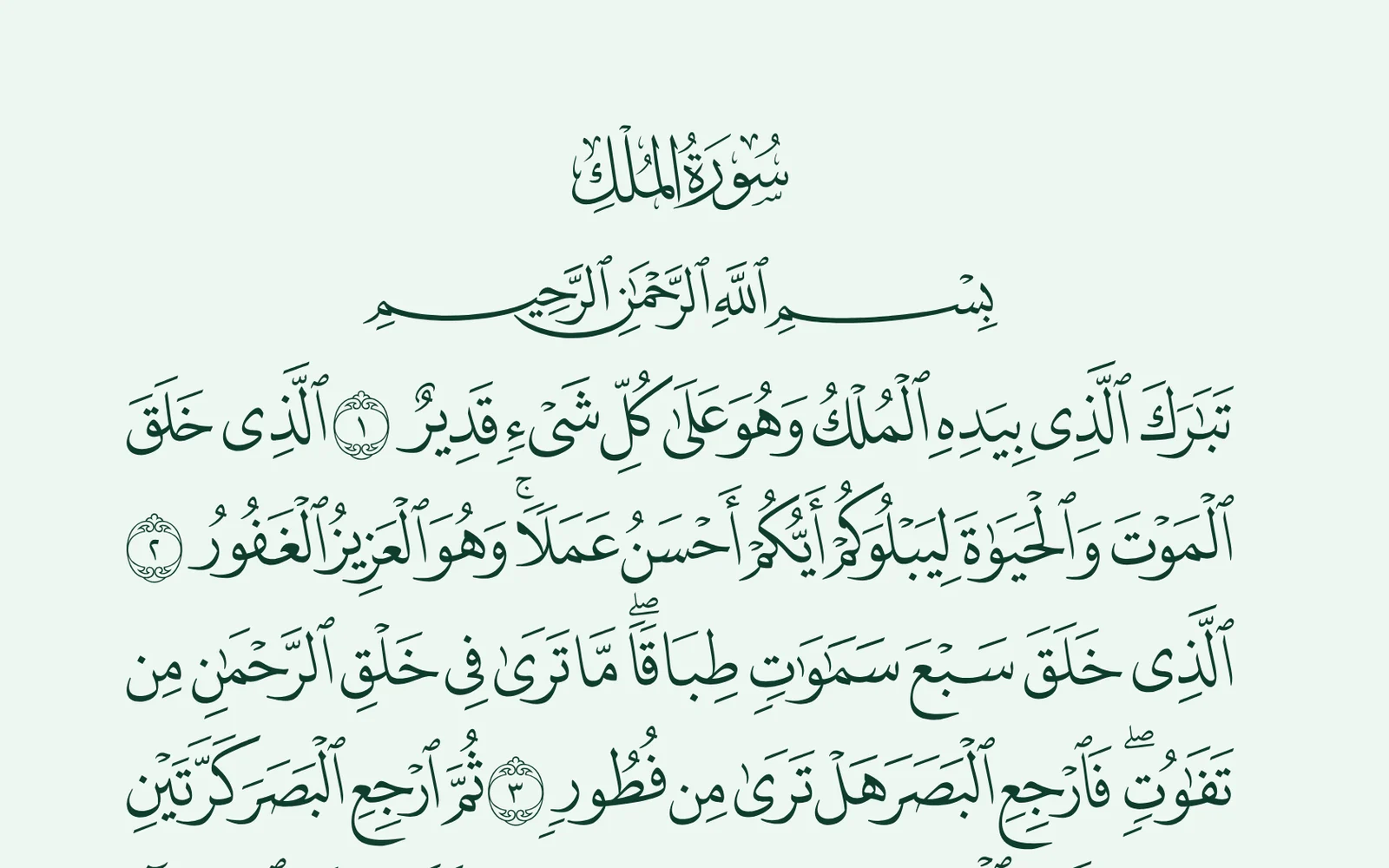
تَبَٰرَكَ ٱلَّذِي بِيَدِهِ ٱلۡمُلۡكُ وَ هُوَ عَلَىٰ كُلِّ شَيۡءࣲ قَدِيرٌ
ٱلَّذِي خَلَقَ ٱلۡمَوۡتَ وَ ٱلۡحَيَوٰةَ لِيَبۡلُوَكُمۡ أَيُّكُمۡ أَحۡسَنُ عَمَلࣰا ۚ وَ هُوَ ٱلۡعَزِيزُ ٱلۡغَفُورُ
What it is about
- Allah’s dominion and the test of life (1–5). Death and life were created as a test of who is best in deeds. Look at the seven heavens again and again: you will find no flaw in them.
- The warning and the regret (6–11). The people of the Fire are asked whether no warner came to them. They answer: “If only we had listened or reasoned, we would not be among the companions of the Blaze.”
- The One who knows (12–14). Those who fear their Lord unseen have forgiveness and a great reward. Whether you hide your words or speak them openly, He knows what is in the hearts — “Does He not know, the One who created?”
- Signs in daily life (15–24). The earth is made easy to walk on and to seek provision in; the birds are held in the sky by none but the Most Merciful; hearing, sight and hearts are His gifts — “little are you grateful.”
- The closing questions (25–30). If your water were to sink away into the earth, who could bring you flowing water?
Its virtue
Abu Hurayrah narrated that the Prophet ﷺ said: “Indeed there is a surah in the Qur’an of thirty verses which intercedes for a man until he is forgiven. It is Tabarak alladhi biyadihil-mulk.”
Abu Dawud records the same hadith with the words “…will intercede for its reader until he is forgiven” (Sunan Abi Dawud 1400), and Ibn Majah has it too (3786).
Reading it at night
Jabir reported that the Prophet ﷺ would not sleep until he had recited Alif Lām Mīm Tanzīl (Surah as-Sajdah) and Tabārak (Surah Al-Mulk) — at-Tirmidhi 2892. Scholars have discussed the chain of this report, but reading Al-Mulk before sleep has long been a habit of Muslims, and the virtue above is not tied to any particular time.
Other reports describe Al-Mulk as a protection from the punishment of the grave; scholars differ on the strength of some of their chains. What is firmly established is the hadith of intercession above — reason enough to make the surah a companion.
Making it a habit
- Read it with its meaning. Five minutes with a translation open beside the Arabic turns recitation into reflection.
- Learn it in parts. Three verses a day and the whole surah is memorised in ten days.
- Listen when you cannot read — on the way home, or before sleep.
Frequently asked questions
How many verses are in Surah Al-Mulk?
Thirty. It is the 67th surah of the Qur’an, revealed in Makkah, and it opens Juz 29.
What is the virtue of Surah Al-Mulk?
The Prophet ﷺ said that a surah of thirty verses, Tabarak alladhi biyadihil-mulk, intercedes for its reader until he is forgiven (at-Tirmidhi 2891, Abu Dawud 1400; graded hasan).
When should Surah Al-Mulk be read?
Any time. Many Muslims read it every night before sleep, following a report from Jabir that the Prophet ﷺ would not sleep until he had recited it.