Quran · · 7 min read
Surah Al-Waqiah: Meaning, Virtues and the Hadith About Poverty
Many Muslims read Surah Al-Waqiah every night, often hoping for provision. Here is what the surah actually says, what is authentic about its virtue — and what is not.
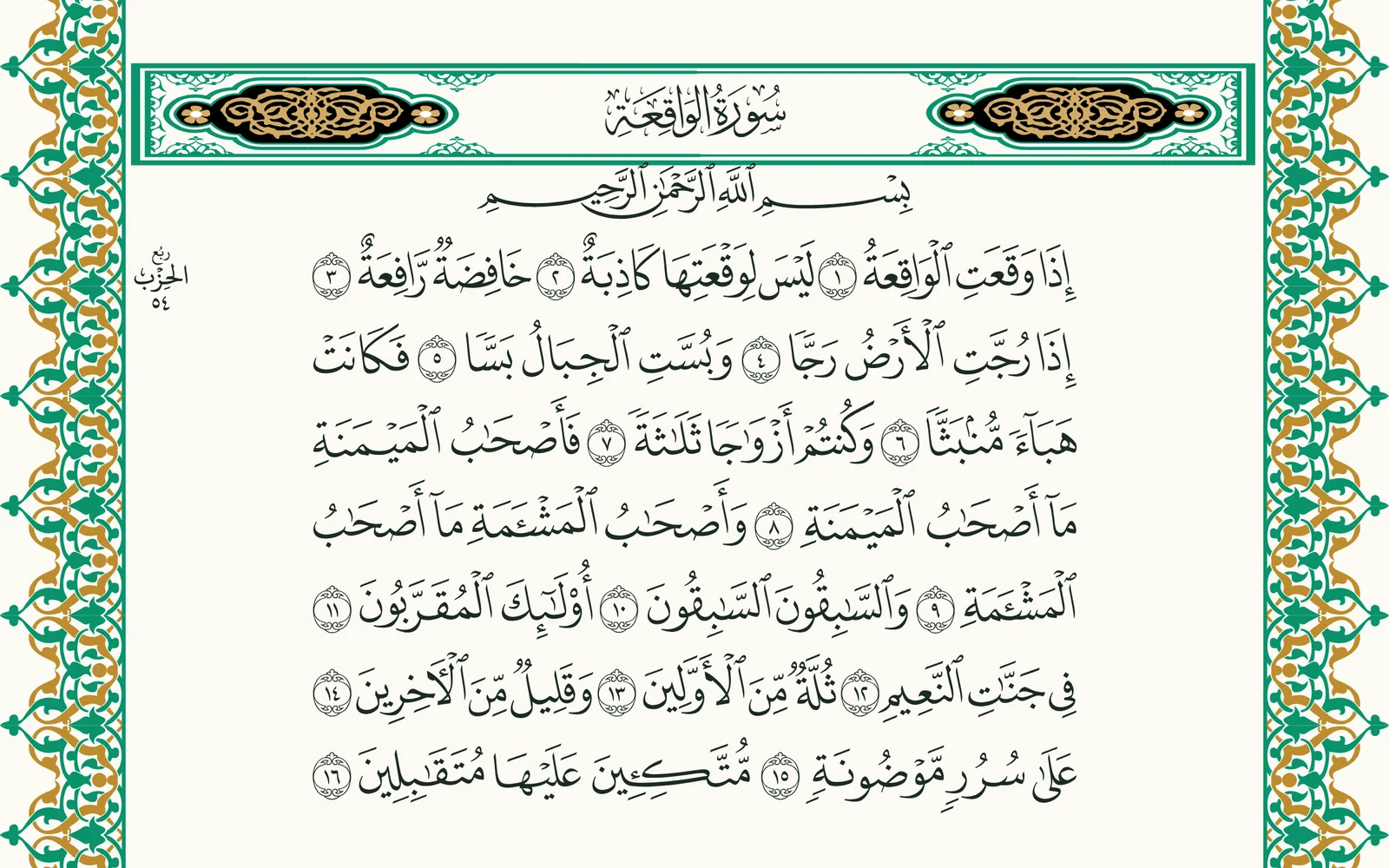
Short answer: Surah Al-Waqiah (“The Inevitable Event”) is the 56th surah of the Qur’an: a Makkan surah of 96 verses in Juz 27, beginning on page 534 of the Madinah Mushaf. It describes the Day of Judgement and the three groups people will be divided into. The popular report that whoever reads it every night will never suffer poverty is graded weak by hadith scholars; the surah’s merit rests on its content and on the general reward for reciting the Qur’an.
About the surah
- Name: Al-Wāqi‘ah, “The Inevitable Event” — a name of the Day of Judgement, taken from its first verse.
- Place: the 56th surah, revealed in Makkah; 96 verses.
- In the Mushaf: Juz 27, starting on page 534 of the Madinah Mushaf, right after Surah Ar-Rahman.
It opens:
إِذَا وَقَعَتِ ٱلۡوَاقِعَةُ
لَيۡسَ لِوَقۡعَتِهَا كَاذِبَةٌ
خَافِضَةࣱ رَّافِعَةٌ
What it is about
- The Event and the three groups (1–56). When the Hour comes, the earth is shaken and the mountains crumble to dust, and people become three groups: as-sābiqūn — the foremost, brought nearest to Allah; the companions of the right; and the companions of the left. The surah describes the gardens of the first two and the scorching wind and boiling water of the third.
- Signs to reflect on (57–74). Who creates the drop of fluid you emit? Who makes the seed you sow grow? Who sends down the water you drink from the clouds? Who produced the tree for the fire you kindle? Each question ends with the call to glorify the name of your Lord, the Most Great.
- The noble Qur’an (75–82). Allah swears by the positions of the stars — “a mighty oath, if you only knew” — that this is a noble Qur’an, in a well-guarded Book, touched only by the purified.
- The moment of death (83–96). When the soul reaches the throat, no one can bring it back. Then the three groups are named again, one last time, and the surah closes with its refrain.
إِنَّهُۥ لَقُرۡءَانࣱ كَرِيمࣱ
لَّا يَمَسُّهُۥٓ إِلَّا ٱلۡمُطَهَّرُونَ
فَسَبِّحۡ بِٱسۡمِ رَبِّكَ ٱلۡعَظِيمِ
What the hadith say about it
Abu Bakr, may Allah be pleased with him, once said to the Prophet ﷺ that grey hair had appeared on him. He answered:
“Hud, Al-Waqi‘ah, Al-Mursalat, ‘Amma yatasa’alun and Idhash-shamsu kuwwirat have turned me grey.”
These surahs describe the Hour and its terrors so vividly that their weight showed on the Prophet ﷺ himself. That is the real “virtue” of Al-Waqiah: it makes the Hereafter present in the heart.
The hadith about poverty — is it authentic?
A widely shared report, attributed to ‘Abdullah ibn Mas‘ud, says: “Whoever recites Surah Al-Waqiah every night will never be afflicted by poverty.” It is recorded by al-Bayhaqi in Shu‘ab al-Iman and others. Hadith scholars — among them Ahmad ibn Hanbal, Abu Hatim and ad-Daraqutni — judged its chain to be weak, and it is not in any of the six major collections.
A weak report is not a basis for a firm promise. Still, reading Al-Waqiah every night is a good practice: every letter of the Qur’an carries reward, and a surah that keeps death, the Judgement and Allah’s blessings before your eyes is a fine companion for the night. Seek provision through the means Allah made — work, prayer, istighfār and gratitude — without attaching a guarantee to one surah.
In the prayer
The refrain of the surah, fa sabbiḥ bismi rabbikal-‘aẓīm — “so glorify the name of your Lord, the Most Great” — is the same glorification Muslims repeat in every bowing: subḥāna rabbiyal-‘aẓīm. A report in Sunan Abi Dawud 869 links the two directly; its chain is graded weak by al-Albani, but the wording of the bowing itself is well established.
Making it a habit
- About 10–12 minutes is enough to recite all 96 verses at a calm pace.
- Read it with the meaning. The surah is built on questions — pause at each one.
- Listen to a reciter you love when you cannot read, for example before sleep.
Frequently asked questions
How many verses are in Surah Al-Waqiah?
Ninety-six. It is the 56th surah of the Qur’an, revealed in Makkah, in Juz 27.
Is the hadith “whoever reads Al-Waqiah every night will never be poor” authentic?
No. It is attributed to Ibn Mas‘ud and recorded by al-Bayhaqi and others, but hadith scholars such as Ahmad, Abu Hatim and ad-Daraqutni graded its chain weak. Reading the surah is still rewarded like all recitation of the Qur’an.
What is Surah Al-Waqiah about?
The Day of Judgement and the three groups people will be divided into — the foremost, the companions of the right and the companions of the left — with signs of Allah’s power in creation and a reminder of the moment of death.
When should Surah Al-Waqiah be read?
At any time. Many Muslims read it at night; no specific time is required.