Prayer · · 7 min read
How Prayer Times Are Calculated: Fajr, Asr and Isha Explained
Every prayer time is tied to the position of the sun. Once you know a city’s coordinates and the date, the times can be calculated precisely — the differences between timetables come from a few choices scholars have made about twilight and shadows.
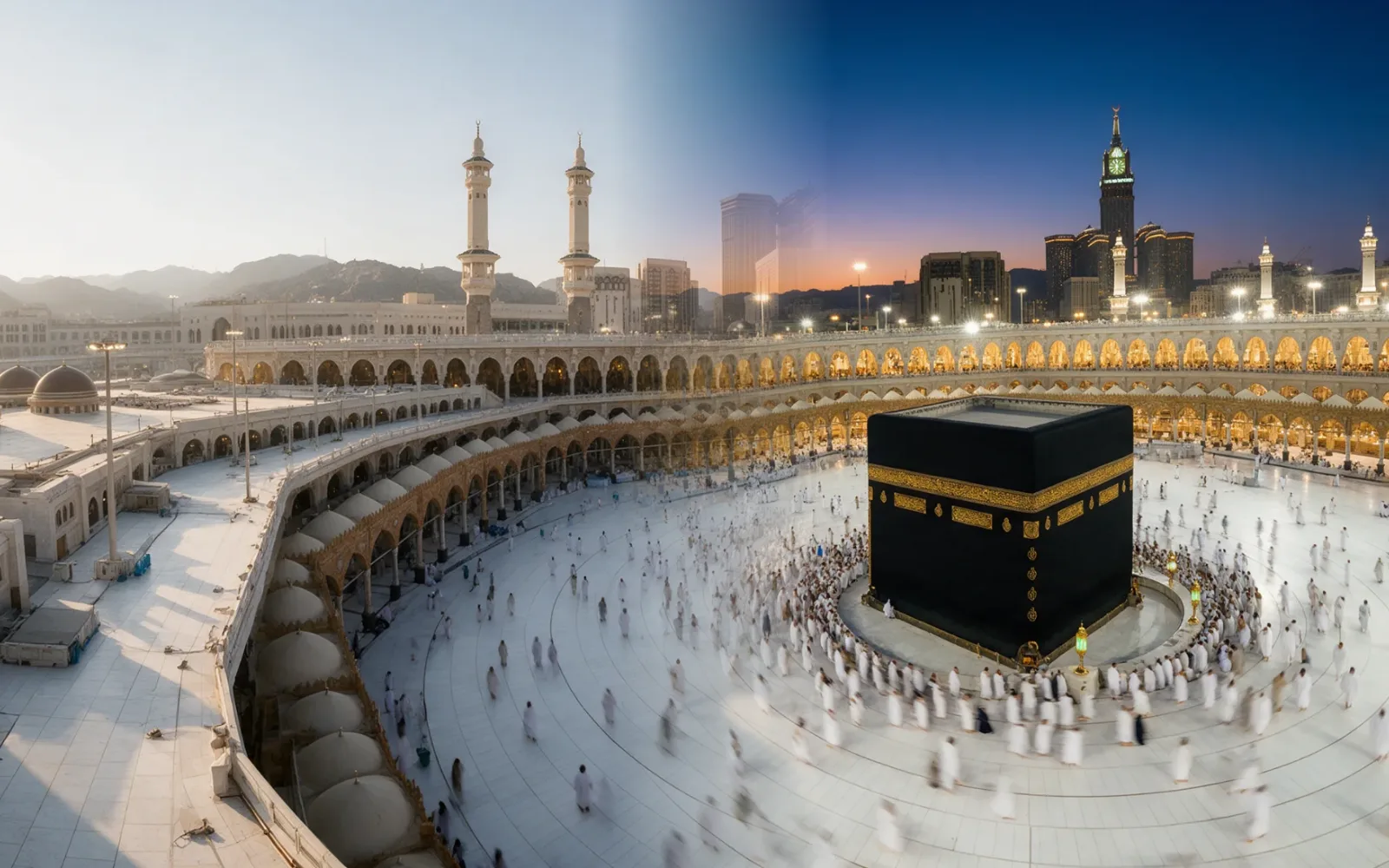
Short answer: Prayer times are calculated from the sun’s position over your city: Fajr and Isha from the sun’s angle below the horizon (15°–19.5°, depending on the method), Dhuhr from solar noon, Asr from the length of shadows (standard or Hanafi) and Maghrib at sunset.
The five prayers and the sun
- Fajr begins at true dawn, when the first light spreads across the horizon, and ends at sunrise.
- Dhuhr begins just after the sun passes its highest point (solar noon).
- Asr begins when the shadow of an object reaches a certain length (see below).
- Maghrib begins at sunset.
- Isha begins when the red twilight has disappeared from the sky.
Sunrise is not a prayer itself, but it marks the end of Fajr time — that is why timetables list it.
Fajr and Isha: the twilight angle
Dawn and dusk do not happen at a single moment: light grows and fades gradually. To turn them into a time, astronomers use the angle of the sun below the horizon. Different institutions settled on slightly different angles:
- Muslim World League: Fajr 18°, Isha 17°.
- ISNA (North America): Fajr 15°, Isha 15°.
- Egyptian General Authority of Survey: Fajr 19.5°, Isha 17.5°.
- Umm al-Qura (Makkah): Fajr 18.5°, Isha 90 minutes after Maghrib (120 in Ramadan).
- University of Islamic Sciences, Karachi: Fajr 18°, Isha 18°.
- Uzbekistan: Noor uses 15.5° for Fajr and 15° for Isha, which matches the official Tashkent timetable within about a minute.
A larger angle means an earlier Fajr and a later Isha. The difference between methods can be 10–20 minutes, which is why Noor uses the official method of each country by default.
Asr: standard and Hanafi
Asr begins when the shadow of an object is as long as the object itself (plus the length of its shadow at noon). This is the view of the Shafi‘i, Maliki and Hanbali schools and is often called standard Asr.
In the Hanafi school, Asr begins when the shadow is twice the object’s length, so Hanafi Asr is later — often by 40 minutes to an hour. Noor uses the Hanafi time in Central Asia, Turkey, the Caucasus, Russia, Pakistan, India and other places where it is the common practice.
Summer nights in the north
In cities such as London, Moscow or Stockholm, the sun may not sink deep enough below the horizon in summer for twilight to end. Then Isha and Fajr cannot be calculated from the angle alone, and a “high latitude rule” is used — for example dividing the night into sevenths. Noor applies the recommended rule automatically.
Why your mosque may differ by a minute or two
- Many timetables add a few minutes of caution (iḥtiyāṭ) to Maghrib, Isha or Fajr.
- Times are calculated for the city centre; the edge of a large city can differ by a minute.
- Some mosques round times or use a fixed Isha time.
When in doubt, follow the timetable of your local mosque or your country’s religious authority.
Frequently asked questions
Why is Fajr earlier in one app than another?
Apps use different twilight angles for Fajr (from 15° to 19.5°). A larger angle gives an earlier Fajr. Noor uses the official method of each country.
What is the difference between Hanafi and standard Asr?
Standard Asr begins when an object’s shadow equals its length; Hanafi Asr begins when the shadow is twice its length, so it is later.
Is sunrise a prayer time?
No. Sunrise marks the end of the time for Fajr.